
Find, Fix, Verify
An SEO Audit That Proves the Fix Worked
KinetixSEO is an SEO and AI-citation (GEO) checker that pairs every finding with a fix, not just a report. It finds each issue, writes a fix for that exact page, and re-scans it once you've applied the fix — so you know it actually went live, not just that you made a change.
Before and after, on the same page
A real verified fix
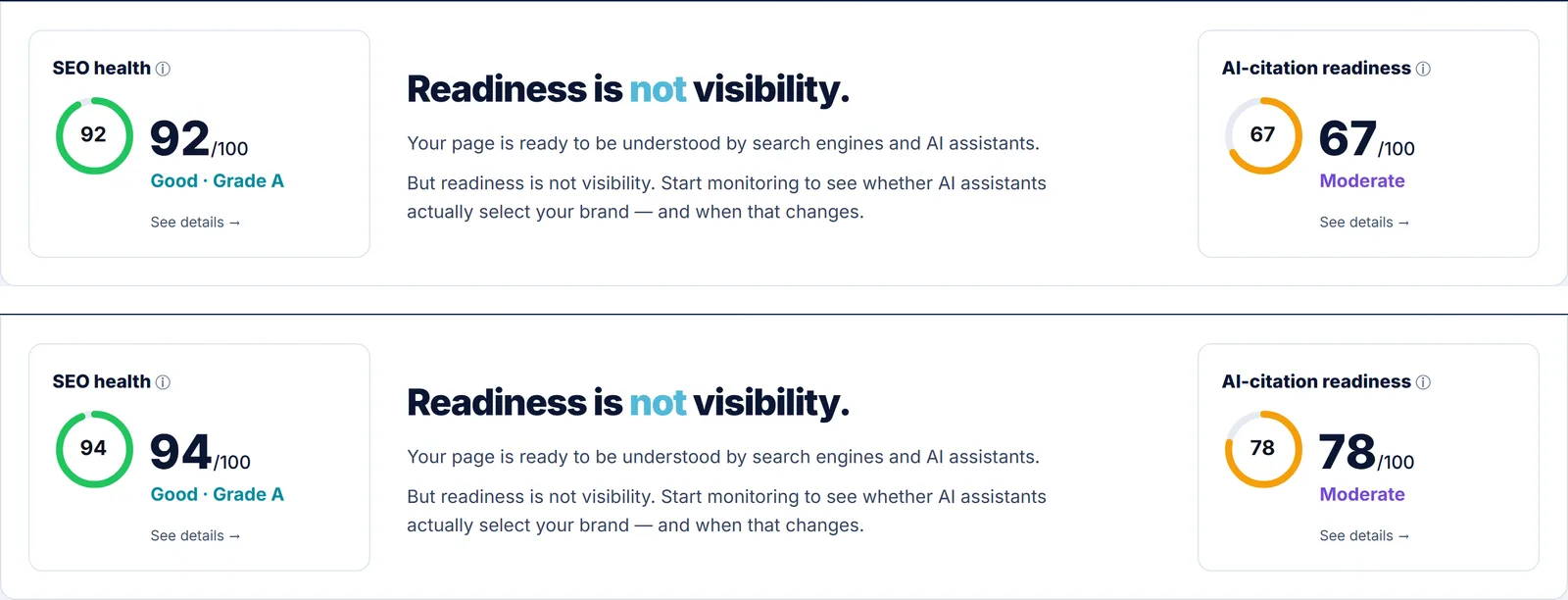
Our own homepage, 1 and 10 August 2026 — SEO health 92 → 94, AI-citation readiness 67 → 78 after acting on the findings. Not our current state: a September redesign traded on-page text and video for interactive components, and readiness had fallen back to 76 by 6 September. Scores move both ways, which is the point of re-checking.
How it works
Three steps, one flow
- 1. Find. A deterministic audit measures your page's real HTML, HTTP headers, and content, and produces a ranked list of findings — free, no signup, for the score alone.
- 2. Fix. A paid analysis adds an AI-written fix for each finding, grounded in that specific page's content — copy-paste text or code, not generic advice. When a fix genuinely needs something only you have, the report says so instead of inventing an answer.
- 3. Verify. Once you've applied your fixes, one re-scan is included with the analysis. It re-measures the page with the same checks and marks each fix verified, not applied, or regressed.
What this doesn't do
The free check gives you the score and findings only — AI-written fixes and the verification re-scan are part of a paid analysis. Verification is one included re-scan per analysis, not continuous monitoring, and no tool can guarantee a ranking change even after every fix verifies.
FAQ
SEO fix verification — FAQ
What makes this different from a normal SEO audit? +
Every KinetixSEO analysis follows the same three-step path — find each issue, hand you a fix written for that exact page, then verify the fix went live with an included re-scan — so you can prove the change worked instead of taking it on faith. Most audits stop at a ranked list of problems and leave you to write the fix yourself and guess whether it landed. Here the fix is grounded in the specific page's own content rather than generic advice, and the verification step re-measures the page with the same deterministic checks used the first time, marking each fix verified, not applied, or regressed rather than leaving the outcome unconfirmed. The report also states plainly when a fix needs something only you have, such as a real business fact or a change only a developer can ship, rather than inventing a generic answer to fill the gap.
Is fix generation part of the free check? +
No, fix generation is not part of the free check. The free check, which requires no signup, gives you the SEO Health Score and the GEO Readiness Score plus the full ranked list of findings on the page you paste in. Page-specific, AI-written fix text and code for each of those findings, along with the included verification re-scan that confirms a fix actually went live, are part of a paid analysis rather than the free check. That split is deliberate: you see exactly what is wrong and how severe it is, with real numbers, before deciding whether to pay for the fixes and the re-scan that confirms them. Both scores are complete on their own in the free check, so there is nothing held back from the score itself, only from the work of fixing what it finds.
How does fix verification actually work? +
Once you have applied a fix, one re-scan is included with your paid analysis. It re-measures the page with the same deterministic checks used the first time and marks each fix as verified, not applied, or regressed, rather than assuming a fix worked just because you say you made the change or the page looks different in a browser. That is a single included verification pass per analysis, not continuous monitoring across every future edit to the page, and not a guarantee that a verified fix alone will move a ranking. If a fix still needs work, the re-scan states the specific reason rather than a plain pass or fail, so you know exactly what to correct next instead of guessing why a change did not register. That single included pass is what separates verification from simply trusting that an applied change was correct.
What happens if a fix doesn't verify? +
It's marked not applied or regressed with the specific reason, so you know exactly what still needs work — the re-scan doesn't just say pass/fail, it tells you what it actually found.
Do I still need a developer to apply the fixes? +
For fixes that are copy-paste text or code, no. For anything that genuinely needs something only you have — a real business fact, or a change only a developer can ship — the report says so plainly instead of inventing an answer.
Start with a free check
See your score first, then decide whether to unlock fixes and verification.