
GEO Audit Tool
Generative Engine Optimization, Measured
KinetixSEO is an SEO and AI-citation (GEO) checker — this free, no-signup audit scores whether your page is structured so AI systems can find, understand, and cite it, the same deterministic way as your SEO Health Score.
How GEO is scored
Five dimensions, weighted
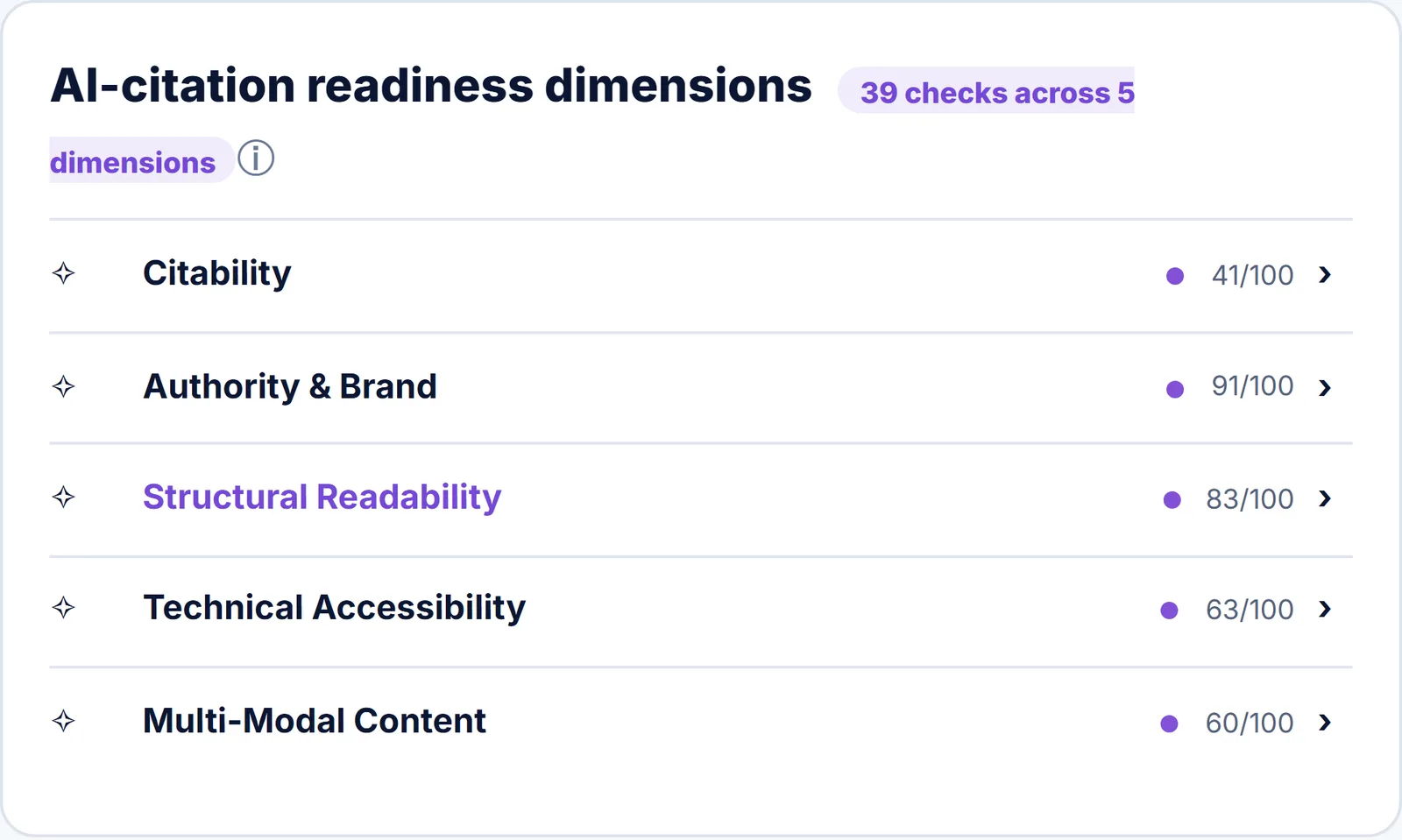
Citability — 25%
A direct answer early on, in passages short enough to quote, backed by numbers rather than bare superlatives.
Authority & Brand — 20%
Author or organization attribution, Organization schema, and a brand name used consistently across title, meta and H1.
Structural Readability — 20%
Question-per-section headings that are actually answered, semantic landmarks, and scannable lists.
Technical Accessibility — 20%
Whether AI crawlers are allowed and can reach the page at all — robots.txt rules and substantive content in the raw HTML. llms.txt and ai.txt are reported but not scored: no answer engine has confirmed reading either.
Multi-Modal Content — 15%
Video, a data table, and several images — formats an answer engine can pull from beyond prose.
Full grading rules, including when the score is capped or withheld, on the Methodology page.
What moving the score looks like
Our own homepage, four weeks apart
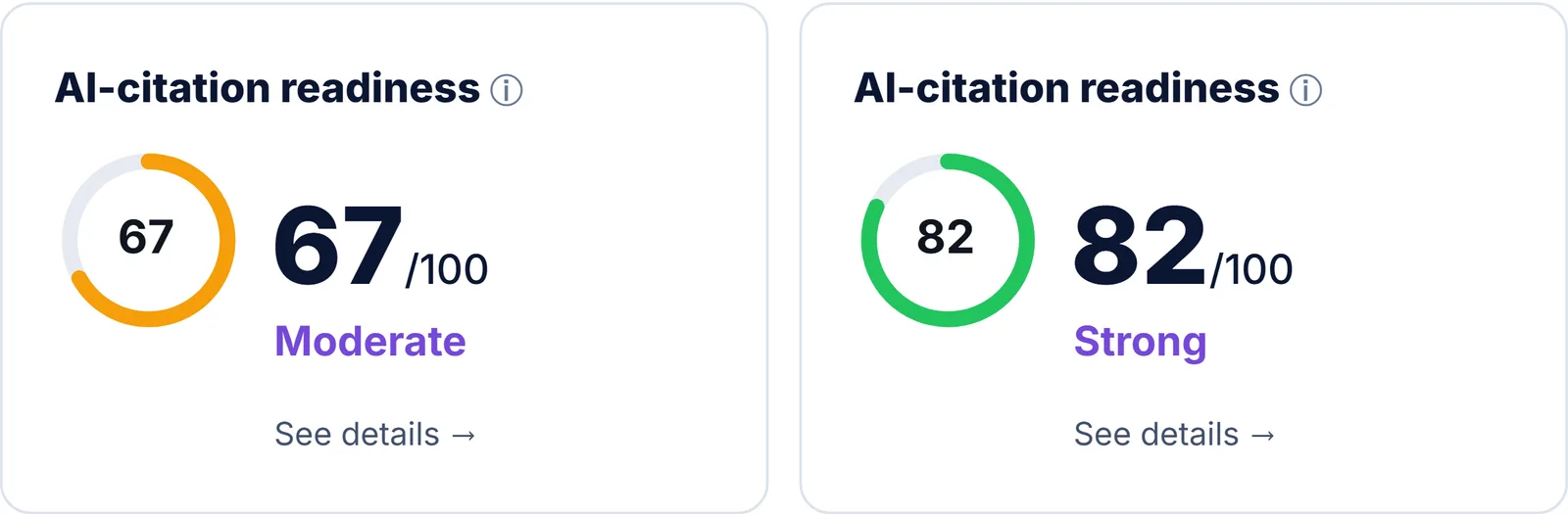
1 and 28 August 2026 — AI-citation readiness 67 to 82, moderate to strong, after we worked through our own findings. Not our current state: a September redesign traded on-page text and video for interactive components and readiness had fallen back to 76 by 6 September. That is the trade we chose, and it is exactly what re-checking is for.
GEO vs. AEO vs. SEO
Related, not the same
Classic SEO targets search-engine ranking. GEO (Generative Engine Optimization) and AEO (Answer Engine Optimization) target the same underlying goal — being found and cited by AI systems — and in practice the two terms overlap heavily across the industry. This audit runs alongside your SEO Health Score, not instead of it, because ranking and AI citation both matter and neither guarantees the other. See our AI search citation statistics for real, first-party data on which sources each AI engine actually cites.
What this doesn't do
No audit tool can guarantee an AI citation — that depends on the AI system's own retrieval and ranking. This measures the structural prerequisites, not the outcome. To see whether you're actually being cited today, pair this with AI citation tracking.
FAQ
GEO audit tool — FAQ
What is a GEO audit? +
A GEO audit measures how ready a specific page is for citation by AI systems such as ChatGPT, Gemini, and Perplexity — the practice itself is called Generative Engine Optimization (GEO): structuring content so those systems can find, understand, and cite it. A GEO audit runs the checks that practice implies against one real page, scoring five weighted dimensions from the page's actual HTML rather than guessing. It is a distinct discipline from classic SEO, which measures ranking potential rather than citation potential, and this audit runs alongside your SEO Health Score rather than instead of it, because a page can succeed at one and fail at the other — a page can rank on page one of Google while its answers are still too buried, too hedged, or too thin for an AI system to quote with confidence.
How is GEO different from AEO (answer engine optimization)? +
The terms overlap heavily and are used interchangeably across the marketing and SEO industry in practice, so this audit does not try to draw a hard line between them. Instead it scores the concrete, checkable signals either term implies: a front-loaded, quotable answer (Citability), author and brand attribution (Authority & Brand), question-per-section formatting (Structural Readability), whether AI crawlers such as GPTBot can actually reach the page (Technical Accessibility), and non-text formats such as video and data tables (Multi-Modal Content). Naming the discipline GEO or AEO does not change which of those five signals a page is missing, and neither label changes how the score is calculated — the same deterministic checks run either way. See the AEO vs. GEO article for the full terminology history and how the two labels emerged in the industry.
What does the GEO Readiness Score actually measure? +
The GEO Readiness Score is a weighted average of five dimensions, each graded from deterministic checks of the page's real HTML: Citability (25%) — a front-loaded answer in a passage short enough to quote cleanly, backed by real numbers; Authority & Brand (20%) — author or organization attribution and a brand name used consistently across title, meta, and heading; Structural Readability (20%) — question-per-section headings that are actually answered; Technical Accessibility (20%) — whether AI crawlers such as GPTBot and ClaudeBot are allowed to fetch the page at all; and Multi-Modal Content (15%) — video, a data table, and several images an answer engine can pull from beyond prose alone. Full grading rules, including exactly when the score is capped or withheld for a category that cannot be measured yet, are on the Methodology page.
Can a GEO audit guarantee my page gets cited by ChatGPT? +
No audit tool can guarantee a citation — that depends on the AI system's own retrieval and ranking, which nobody outside those companies controls. A GEO audit tells you whether the structural prerequisites for citation are in place; it does not and cannot promise the citation itself.
Is the GEO audit free? +
Yes — the GEO Readiness Score is part of the same free, no-signup check as the SEO Health Score. One URL, both scores.
Run your free GEO audit
Free, no signup — one URL, both scores.