
AI Citation Tracker
Know When AI Engines Actually Mention You
KinetixSEO is an SEO and AI-citation (GEO) checker — start with the free GEO Readiness check, no account needed, then track whether ChatGPT, Google AI Overviews, Google AI Mode, Gemini, Claude, Perplexity, Microsoft Copilot, Grok and DeepSeek cite your brand when asked questions relevant to your business — the genuinely different part of AI visibility from just being structurally "ready."
Track whether AI answers cite you
Real answers, not estimates
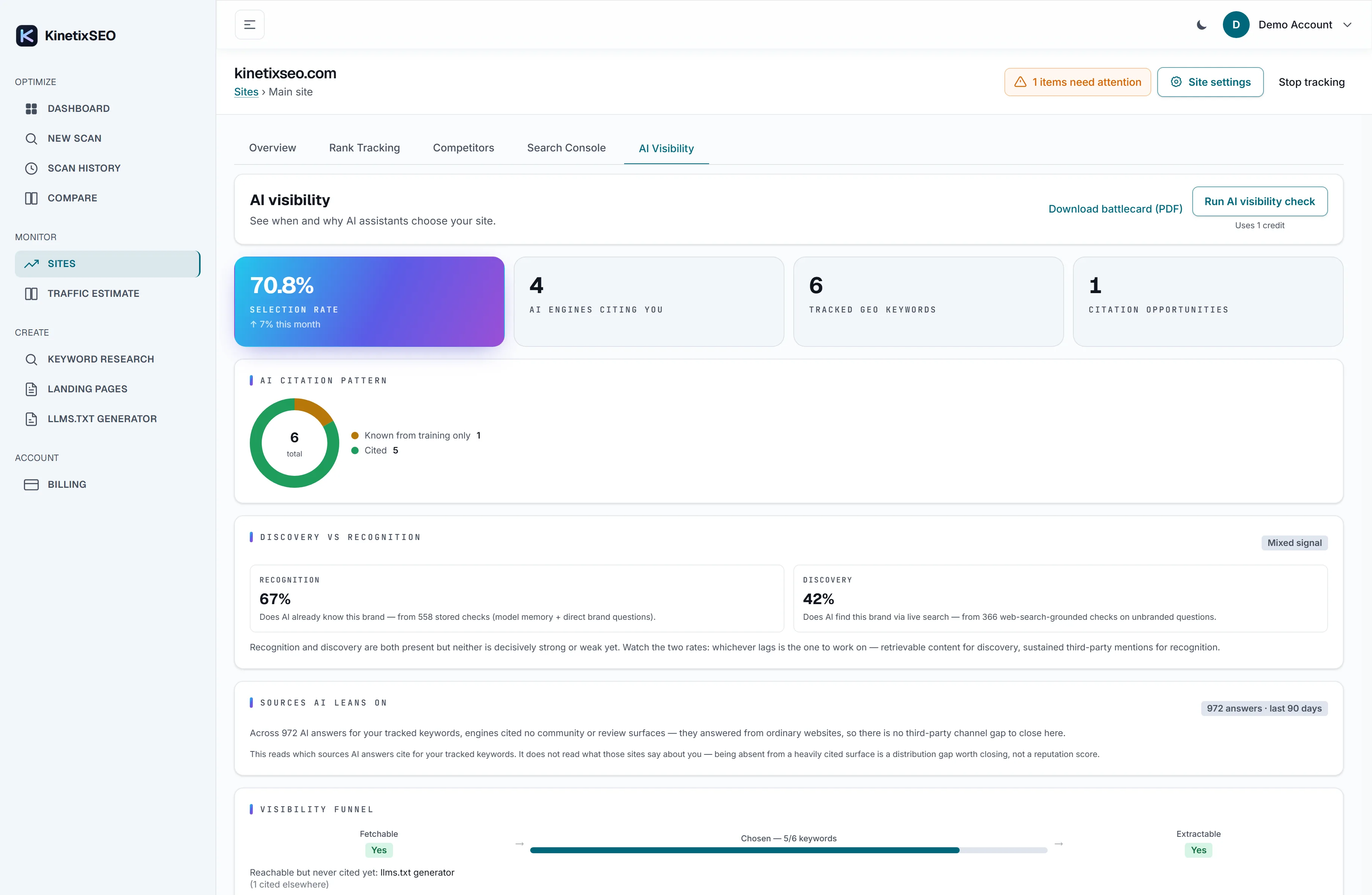
Citation checks run against prompts you choose, across ChatGPT, Google AI Overviews, Google AI Mode, Gemini, Claude, Perplexity, Microsoft Copilot, Grok and DeepSeek, and record whether and how your brand is mentioned — including sentiment, not just a yes/no. For industry-wide numbers on which kinds of sources each engine cites, see our AI search citation statistics.
Why this is different from a one-off audit
Readiness vs. reality
A GEO audit is a one-time structural check of a single page: is it built to be citable. Citation tracking is ongoing measurement of what is actually happening — whether a real prompt to a real AI system surfaces your brand today, not just whether the page is structured well enough to be citable. The two are complementary: a GEO audit's weighted score covers five dimensions — citability, authority and brand, structural readability, technical accessibility, and multi-modal content — and tells you what to fix on the page itself. Citation tracking then confirms whether those fixes changed what ChatGPT, Google AI Overviews, Google AI Mode, Gemini, Claude, Perplexity, Microsoft Copilot, Grok and DeepSeek actually say about your brand when a real prompt is run. Citation quality and sentiment carry more weight than raw mention count, since a single mention in the wrong context does not mean the same thing as a positive, on-topic citation.
What this doesn't do
Citation tracking cannot observe every conversation happening on ChatGPT or Gemini worldwide, and it cannot guarantee a citation — it samples the specific prompts you define on a recurring schedule and reports what actually happened when those prompts were asked. That means the results are only as broad as the prompts you choose to track, and a prompt you never added will never show up in your report. The tool reports the outcome honestly, including a result of "not mentioned," rather than smoothing over a miss to make the dashboard look better.
FAQ
AI citation tracker — FAQ
What is AI citation tracking? +
AI citation tracking is ongoing monitoring of whether AI systems mention or cite your brand when asked questions relevant to your business. It is a different measurement from a GEO Readiness check, which scores whether a single page is structured to be citable — a weighted average across five dimensions: citability, authority and brand, structural readability, technical accessibility, and multi-modal content. A GEO Readiness score tells you your odds before the fact, based on how the page itself is built. Citation tracking tells you the outcome: whether a real prompt to a real AI system actually surfaces your brand today, across the engines you track. The two measurements are complementary rather than interchangeable — a page can score well on readiness and still go unmentioned in a given AI answer, and tracking is the only way to see that gap.
Which AI engines does the tracker cover? +
The tracker currently covers ChatGPT, Google AI Overviews, Google AI Mode, Gemini, Claude, Perplexity, Microsoft Copilot, Grok and DeepSeek, checked on a recurring schedule against a set of prompts you choose. Coverage is not a live crawl of every possible query across the internet — it only extends as far as the prompts you decide to track, so choosing prompts that match how your real customers ask questions matters more than the number of prompts you add. Add or remove prompts at any time, and every check going forward runs against the current list.
Is AI citation tracking free? +
A one-off GEO Readiness Score is free with no signup and no card required, and it checks a single page's structure across five weighted dimensions — citability, authority and brand, structural readability, technical accessibility, and multi-modal content. Ongoing citation tracking is included in every paid plan: each tracked keyword's base prompt is checked weekly across ChatGPT, Google AI Overviews, Google AI Mode, Gemini, Claude, Perplexity, Microsoft Copilot, Grok and DeepSeek, and the sentiment-tagged results are stored over time, at no extra credit cost. Extra prompts (up to three per keyword) and on-demand checks do spend credits, because each one is another paid call to every engine. If you only need to know whether one page is built to be citable, the free check answers that in a minute with no account and no repeat cost. If you need to know whether AI engines are actually mentioning your brand today, that requires a paid plan and a list of tracked keywords, checked weekly from then on.
How often are citations checked? +
Checks run weekly against the prompts you track, not continuously against every AI response worldwide. There is no way to observe every conversation happening on ChatGPT or Gemini in real time — the tracker instead samples the specific prompts you define at a set interval and records whether your brand appears each time. That sampling approach is what makes the results honest: a prompt is checked when it's checked, and the report shows exactly when each result was captured rather than implying constant, live surveillance that no tool can actually deliver.
What's the difference between citation tracking and a GEO audit? +
A GEO audit is a one-time structural check of a single page, scored across five weighted dimensions — citability, authority and brand, structural readability, technical accessibility, and multi-modal content — to see whether the page is built to be citable at all. Citation tracking is ongoing measurement of actual mentions across AI engines: does a real prompt to one of the engines you track surface your brand today, and with what sentiment attached to it. The two are complementary rather than competing — fix what the audit finds on the page itself, then use tracking to confirm whether those fixes actually changed what AI systems say about your brand across the engines you track, not just whether a mention happened at all. Run the audit first, then add ongoing tracking once you have something on the page worth measuring.
Start tracking AI citations
Or try the free GEO Readiness check first — no account needed.